I've seen it all. People losing $300 to vendors who disappeared the second the Bitcoin hit their wallet. Cards that looked incredible in the listing photos but arrived looking like they were printed on a 1995 inkjet. The fake id online market is genuinely difficult to navigate if you don't know what to look for, and most buyers learn the hard way.
If you're planning to buy fake id online in 2026, you need to stop thinking like a regular consumer and start thinking like a skeptic. The vendors worth your money have no problem proving their quality. The ones who aren't worth your time will dodge, deflect, and disappear. Here is the exact checklist I use when vetting any new shop — if a vendor can't satisfy every point, close the tab.
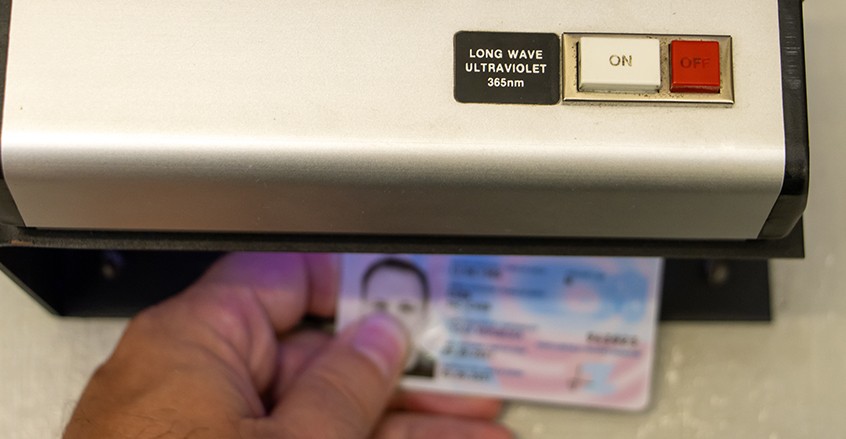
1. Demand a 365nm UV Test Photo of Your Exact State
Every fake id vendor on the internet claims their cards have UV security features. In reality, about 90% of the scannable fake id products you see are using 395nm ink — the cheap stuff that glows purple under any blacklight — or worse, they're using a basic fluorescent coating that's invisible under professional lamps. In 2026, you need 365nm-specific phosphors, full stop.
Ask for a photo of the specific state you're ordering, lit with a 365nm lamp, taken in a genuinely dark room. Then do a reverse image search on that photo. If the same image appears on three other vendor sites, you've caught a stock photo fraudster who doesn't actually own the equipment they're claiming. Legitimate vendors have fresh, unique UV photos because they're taken for each production run. Also check for registration — the UV should align perfectly with the printed design beneath it. Generic overlays that don't match the state layout are the clearest sign of a cheap pre-made laminate that gets applied to every card regardless of state.
2. The Polycarbonate vs. PVC Trap
This is the most expensive hidden lie in the industry. Polycarbonate card stock costs significantly more per blank than PVC. Manufacturers who want to maximize margins will either substitute PVC entirely or use a thin PC laminate over a PVC core and call the result Polycarbonate. Both approaches are a scam.
The test is simple: ask the vendor for a short video of them handling the card. A PVC card will crease and turn white if you fold it even slightly. A genuine Polycarbonate card will flex under pressure and snap back perfectly without a mark. Drop it on a hard surface — real PC makes a distinctly metallic sound. Also ask if the text is laser-engraved into the card or printed on the surface. Laser engraving on PC means the text is inside the card layers, impossible to scratch off. If the vendor describes their process as printing on top of the card, it's PVC with a glossy coat, regardless of what they call it.
3. Ask About Their AAMVA Standard Version
This one question separates professional vendors from amateurs immediately. The AAMVA (American Association of Motor Vehicle Administrators) publishes the technical standard that defines how ID barcode data must be structured. There are multiple versions — in 2026, most states use Version 8 or 9. If a vendor is still running Version 5 or 6 templates, which were common in 2018, a modern scanner will return Inconsistent Data or Outdated Format errors even if the barcode technically reads.
Just ask directly: which AAMVA version do you use for [your state]? If they answer confidently with a specific version number, that's a green flag. If they say something like our barcodes work great or we've never had complaints, that's a dodge. Vendors who truly encode their cards correctly are proud of it — it's expensive to maintain updated templates for every state, and the ones who do want you to know that.
4. Read Reviews on Third-Party Platforms Only
Reviews on a vendor's own website are useless. I don't say that to be harsh — it's just reality. Any vendor can write their own reviews, import AI-generated testimonials, or pay for five-star ratings. The only reviews that carry any weight come from independent forums, subreddits, or community review aggregators that vendors have no control over.
When reading third-party reviews, look specifically for macro photographs of the actual card. If a reviewer can show you a sharp close-up photo of the microprinting under a loupe and the text is legible, that vendor is using high-DPI printing equipment. Look at the ghost image quality. In a real photo taken in natural light, you can see whether the ghost image is a flat print or a true laser ablation — the latter has a slightly different sheen and depth. If every review is text-only with no photos, be cautious. Anyone can write words. Photos of real cards are much harder to fake.
5. Test Their Photo Requirements Process
This is a subtle but reliable quality signal. When you contact a vendor about ordering, pay close attention to what they tell you about your photo. If a vendor says something like just send any photo and we'll make it work, they are not running a quality operation. High-quality card production requires a high-quality source image, and a professional vendor knows this.
A legitimate shop will have specific requirements: neutral background (usually white or light grey), even front-facing lighting with no shadows, minimum 300 DPI resolution, face clearly visible and centered. Some will offer to professionally edit your photo to match state-specific formatting requirements. That service costs them time and resources — it's something vendors only offer if they actually care about the end result. If they take any photo you send, they're running a high-volume low-quality operation that treats your order as a number, not a product.
6. Verify Payment Security and Shipping Practices
Any vendor accepting credit cards directly through their site is either naive or operating recklessly. Credit card payments create financial paper trails and chargebacks that legitimate novelty vendors avoid. Professional operations use cryptocurrency — Bitcoin, USDT, or Monero — and provide encrypted communication channels for order details.
Shipping should be described explicitly as discreet. Your package should arrive looking like an ordinary letter or small commercial shipment — nothing on the exterior that indicates the contents. Vendors who provide tracking numbers and route transparency are the ones who've built reliable logistics partnerships. Anyone who promises guaranteed delivery without a tracking number is either lying or shipping through channels with no accountability. Ask specifically: what does the outer packaging look like? A vendor who knows their shipping process will answer without hesitation.
Ordering from a vendor you can actually trust changes the entire experience. Use this checklist before you commit to anyone. The vendors who pass every point aren't common, but they exist — and they're the only ones worth your money. When you're ready to order, browse our novelty ID collection and see our full production and shipping transparency policy.